Sunday, June 01, 2008

AZKINTUWE

La versión electrónica del periódico mapuche Azkintuwe, fundado el 12 de octubre del 2003, se puede encontrar golpeando en el siguiente enlace:


http://www.azkintuwe.org/


Se publica la portada del último suplemento dominical dedicado a las mujeres indígenas chilenas.

Saturday, May 31, 2008

MAYUPAK WAWA

Ch'aska Anka Ninawaman (Cuzco). Poeta quechua y profesora en INALCO (Institute National des Langues et Civilizations Orientales, París, Francia). Ha publicado “La producción literaria en el idioma quechua como una alternativa en el fortalecimiento de la identidad e interculturalidad”. En Identidad lingüística de los pueblos indígenas de la región andina. Editores Ariruma Kowii y J A Fernández Silva, 153-177. Quito, Ecuador: Universidad Andina Simón Bolívar, Sede Ecuador: Ediciones Abya-Yala; Roma, Italia: Instituto Ítalo-Latino Americano, 2005 y Poesía en Quechua Chaskaschay. Quito, Ecuador: Abya Yala, 2004.
MAYUPAK WAWA

Hatun wamra mayu,
puka wamra kaka,
kashkallata niway,
pipak churitak kani.

Mayupak churimari kani,
yakushina wakashpa purinkapak,
kakapak churimari kani,
rumishina urmankapak.

Mayupa churi kakpika
mayu aysashpa apawachun.
kakapak churi kakpika
kakatak llapiwachun.

Wamra mayu,
kaka wamra,
ñuka shutillata killkay,
mayupak churi kashpapash,
kakapak churi kashpapash.

Mayupak uyari,
kakapak yachapay tapunimi:
taytapa shutintachu apani.

Mayupak churi kashpapash,
kakapa churi kashpapash,
Ecuador gubirnupak riksishkami kani.

Traduccion al castellano

EL HIJO DEL RIO

Río grande y soltero,
barranco rojo y soltero,
díganme la verdad
¿Soy tu hijo señor río,
para vagar llorando como el agua?
¿Soy tu niño hombre barranco,
para desmoronarme como cascajo?
Que me arrastren las aguas
si soy el hijo del río.
Que me aplasten las rocas
si soy el hijo del barranco.

Río soltero,
barranco soltero,
firmen mi nombre en papel sellado,
por más que sea niño del barranco,
por más que sea hijo del río grande.

Sonido del río,
rugido del barranco:
¿Estoy con el apellido de mi padre?

Aunque soy niño río,
aunque soy niño barranco,
para el gobierno peruano reconocido estoy en papel sellado.

Fuente: http://www.omni-bus.com/n12/poemas.html

Mas escritos de Ch'aska:

http://www.omni-bus.com/n13/chasca.html

Tuesday, May 27, 2008

CONTESTED MODERNITIES

CALL FOR PAPERS

Contested Modernities: Indigenous and Afro-descendant Struggles in Latin America

The 2009 Lozano Long Conference sponsored by the Teresa Lozano Long Institute of Latin American Studies will have as a topic Contested Modernities: Indigenous and Afrodescendant Experiences in Latin America. This will be a scholarly gathering to discuss the specific contours of disparate modern experiences in Mesoamerica, the Caribbean and the Andes, where ethnic markers led to fundamentally distinct modernizing processes than elsewhere in the continent.

Considerable progress has been made in scholarship over the past two decades, to address the numerous conceptual failings that had left Afro-descendant and indigenous peoples invisible or marginalized in relation to dominant narratives and analytical frames. To an important degree, these contestations have been carried out by indigenous and Afro-descendant intellectuals themselves, in a way that has served to highlight the closely intertwined relationship between scholarly trends and societal politics. Yet an important facet of this scholarly transformation remains woefully incomplete, perhaps reflecting the difficulties of the corresponding political challenge. It is generally acknowledged that Afro-descendant and indigenous peoples face parallel histories of racism and oppression, and that their struggles for rights and redress follow similar patterns as well. But when it comes to empirical research and sustained analytical work, the most common pattern is to address the two separately, rather than viewing both in the same analytical lens. In the realm of literature and literary analysis a similar pattern holds. There surely are sound political and analytical reasons in particular cases. But the divide itself, and the different emphases within each body of scholarship, also betray some suspicious parallels to the racial ideologies to which both peoples have been subjected over the past 500 years.

This conference will be dedicated to probing this divide, by showcasing scholarship and political interventions that place indigenous and Afro-descendant peoples in the same analytical lens. We seek to explore and problematize this divide, without assuming that it should be eliminated, or that it should stay in place. Rather, our guiding premise is that rigorous historical, humanistic, and social analysis of the underlying question will both energize scholarly debates, and contribute to the bridge-building of commonality and difference, from which the struggles of both peoples stand to benefit.

The conference will be held at the University of Texas at Austin on 26 to 28 February 2009.

The Keynote Speaker will be Boaventura de Sousa Santos, Professor of Sociology at the School of Economics, University of Coimbra (Portugal), Distinguished Legal Scholar at the University of Wisconsin-Madison Law School, Director of the Center for Social Studies of the University of Coimbra and Director of the Center of Documentation on the Revolution of 1974 at the same University. His most recent books in English are Democratizing Democracy: Beyond the Liberal Democratic Canon (2007), and The Rise of the Global Left: The World Social Forum and Beyond (2006). He is one of the founders of the World Social Forum.

Other invited speakers include James Anaya, James J. Lenoir Professor of Human Rights Law and Policy at the University of Arizona James E. Rogers College of Law and United Nations Special Rapporteur on human rights and fundamental freedoms of indigenous people; Ginetta Candelario, Associate Professor of Sociology and Latin American and Latino/a Studies at Smith College, an expert on Dominican communities and identity formations, race and ethnicity in the Americas, Latina/o communities and identity formations, and Latina feminisms; Arturo Escobar, Distinguished Kenan Professor of Anthropology at the University of North Carolina at Chapel Hill, whose most recent work identifies the political ecology framework developed by the Colombian region's social movement of black communities, and suggests that this framework contains important elements for rethinking sustainability and biodiversity conservation; Michael Hanchard, Professor of Political Science at Johns Hopkins University who has written widely on black politics, race in Latin America, and comparative racial politics; Aida Hernandez, Researcher-Professor at CIESAS (Center for Advanced Studies in Social Anthropology) in Mexico City who has worked and lived among Guatemalan refugees and Chiapas' indigenous peoples on the southern Mexican border since 1986 and is the author of Histories and Stories from Chiapas: Border Identities in Southern Mexico; Bettina Ngweno, Assistant Professor of African and African American Studies at the University of California, Davis, whose recent book, Turf Wars: Territory and Citizenship in the Contemporary State analyzes the local, national, and international construction and transformation of the state by examining Afro-Colombian struggles over territory and citizenship; Irmalicia Velasquez Nimatuj, Guatemalan K'iche', Maya anthropologist working on ethnicity, gender, democratization, and globalization; and Catherine Walsh, Professor of Social and Global Studies and Director of Latin American Cultural Studies at the Universidad Andina Simon Bolivar, in Ecuador, who has worked with Indigenous movements for many years, and is now involved with the emergent Afro-Ecuadorian movement.

These scholars have all been centrally involved in debates about Afro-descendant and/or indigenous politics, culture, and history in Latin America. They will anchor the various thematic areas around which the conference panels will be organized, which include but are not limited to:

1) Post-capitalist, post-liberal, and post-statist societies;

2) Alternative modernizations or the end of coloniality;

3)Artistic manifestations of disparate cultural experiences;

4) Points of convergence and points of divergence in indigenous and Afrodescendant experiences;

5) Legal and political struggles for rights and new citizenship regimes;

6) Communal systems, stability, non-capitalist practices and non-state forms of power;

7) Human rights, indigenous communities, and Afrodescendant communities; and

8) Religious practices and alternative modernizations.

Those interested in participating should send their abstracts (between 250 and 300 words) as well as a short bio-bibliographical notice (200 words) to the two convenors: Dr. Arturo Arias and Dr. Charles R. Hale, at Arturo_arias@mail.utexas.edu and crhale@mail.utexas.edu. The deadline for sending the proposals is October 1, 2008. Acceptance will be notified by November 15, 2008. Be sure that the abstract makes clear the connection between your paper proposal and the concept statement of the Conference.

Thursday, May 22, 2008

REEDITAN A JAVIER CASTELLANOS

REEDITAN EN OAXACA “CANTARES DE LOS VIENTOS PRIMERIZOS”, NOVELA DE JAVIER CASTELLANOS

Ángel Trejo


El Instituto Estatal de Educación para Adultos de Oaxaca inició la publicación de su serie bibliográfica Voces de mi pueblo, la cual estará dedicada a la difusión de obras literarias en las 16 lenguas indígenas que se hablan en esa entidad, con la reedición bilingüe de la novela Cantares de los vientos primerizos, del escritor zapoteco Javier Castellanos, Premio Nezahualcóyotl de Literatura 2002.

Publicada inicialmente en 1994 por Editorial Diana y el Consejo Nacional para la Cultura y las Artes (CNCA), Cantares de los vientos primerizos está considerada como una de las novelas mexicanas más originales y bellas de la última década del siglo XX.

Igual valoración mereció Relación de hazañas del hijo del Relámpago, novela con la que Javier Castellanos obtuvo ocho años después el Premio Nezahualcóyotl, certamen literario organizado por la Dirección General de Culturas Populares del CNCA.

Ambos textos han sido objeto de estudios literarios por parte de investigadores universitarios de Estados Unidos, España y Argentina, para la obtención de títulos de posgrado.

En la contraportada de la primera edición de Cantares de los vientos primerizos, reproducida también en esta reimpresión, el escritor e investigador especializado en literaturas indígenas de México, Carlos Montemayor, resaltó la “condición indudable de gran escritor de Javier Castellanos”.

En el mismo texto Montemayor elogió la gran precisión artística, la naturalidad y la “difícil sencillez” con la que Castellanos describe la transformación que sufre un zapoteco de la Sierra norte de Oaxaca, quien primero emigró de su pueblo a la capital del estado, luego a México y, finalmente, regresó a su pueblo.

Wila che be ze lhao (Cantares de los vientos primerizos) fue escrita originalmente en zapoteco y vertida al español por el propio Castellanos. Es narrada en primera persona por Jaime, el personaje central, quien cuenta una historia de amor que lo hizo perder un destino mejor como maestro bilingüe e investigador de literatura oral indígena al servicio de una institución antropológica gubernamental, acaso el desaparecido Instituto Nacional Indigenista.

La trama de la novela está ubicada en un ámbito intemporal que permite a Castellanos contar hechos históricos, mitos, leyendas y anécdotas que abarcan más de 500 años, pues los trances proféticos e “historicistas” de Trhon Lia (Petrona María), una shibedao (sabia depositaria de la cultura zapoteca) enamorada de Jaime, lo mismo hacen referencia a la migración de los zapotecos de la región de los valles centrales a la Sierra norte ante la invasión azteca de los siglos XIV y XV, que a las guerras de resistencia que los 20 pueblos xhon de esta región brindaron a los conquistadores españoles del siglo XVI al XVIII.

Drama amoroso, aventurero y picaresco de Jaime y la tragedia familiar que enfrentó Trhon Lia, hermosa zapoteca que vivía sola con dos hijos porque su marido, Zenobio Chimil, residía en Estados Unidos como trabajador migratorio. Este contenido ubica la novela en el contexto histórico actual, quizás a finales de los años 80 y principios de los 90.

Los personajes principales son pocos. Además de Jaime y Trhon Lia, hay una casera medio alcahueta, doña Madarhen (Magdalena), una antropóloga anónima, blanca y de procedencia urbana; Shebe, un hermano del protagonista central, y decenas de personajes secundarios o aleatorios.

La estructura narrativa es mucho más compleja de lo que parecer tener el relato en primera persona con su fluidez rítmica aparentemente oral, en la cual es perceptible la prosodia de la lengua zapoteca que, al igual que la mayoría de las lenguas indígenas mexicanas, no tiene correspondencia con la sintaxis ni la ortografía de la lengua castellana.

La versión en español de Cantares de los vientos primerizos respeta estas diferencias y en todo momento busca preservar los sonidos, ritmos y fórmulas ornamentales de la poesía indígena, mediante el uso ponderado de metáforas y otros recursos retóricos como la aliteración.

La novela está escrita como un canto, se ofrece precisamente como una “voz de los vientos”, pero su composición es moderna.

El primer párrafo evidencia estas características y el dominio de una voz magistral que sabe contar una historia con la ”difícil sencillez” o “difícil facilidad” de los grandes narradores de todos los tiempos:

Ya quedó lejos el tiempo cuando salí de nuestro pueblo, salí gracias a la pobreza que padecemos, salí porque mis finados padres ya no querían que yo viera los sufrimientos por los que ha estado pasando nuestro pueblo.

Javier Castellanos Martínez nació en 1951 en Yojovi, Oaxaca. Es autor de alrededor de 20 títulos de novela, cuento, teatro, historia, biografía (Benito Juárez), monografía, gramática y leyendas. Tiene tres libros inéditos: El corazón de los deseos (novela); De esperanzas y maldiciones (leyendas) y Lha bene (Nombre propio) instructivo para enseñar zapoteco.

Wednesday, May 21, 2008

BERICHA


Pueden encontrar en linea el libro Tengo los pies en la cabeza de Esperanza Aguablanca, "Bericha". Hacer un click en el siguiente enlace. Cuando aparezca el indice hacer click en cada capitulo para leer el libro.

http://www.lablaa.org/blaavirtual/modosycostumbres/tengo/indice.htm

Friday, May 09, 2008

SCRIPTS AND SIGNS IN PRE-COLUMBIAN AMERICA

October 11-12, 2008

Dumbarton Oaks, Washington, D.C. Annual Symposium

"Scripts, Signs, and Notational Systems in Pre-Columbian America"

Dumbarton Oaks is pleased to announce the annual Pre-Columbian Symposium will be held this year in the Music Room of Dumbarton Oaksin Washington, D.C.

Organized with Elizabeth Boone and Gary Urton, the symposium will focus on record-keeping in Pre-ColumbianMesoamerica and the Andean region.

Sessions will begin at 9:00 a.m.on Saturday, 11 October, and conclude on Sunday afternoon.

Long before Europeans came to the American shores, groups or classesof people charged with record-keeping in Mesoamerica and the Andes developed graphic and visual-tactile systems to record and pass on information concerning their understanding of the world theyexperienced. Indeed the Americas--along with Mesopotamia, Egypt, andChina--was one of only four locales where writing developed independently. This conference is not concerned with identifying, defining, or separating out "writing" from other signing and communication systems within Pre-Columbian societies. Rather, the gathering is intended to gain critical and comparative insights into the types of sign, script, and notational systems devised by indigenous Americans for the purposes of recording and conveying knowledge and information. To these ends, speakers will address the relevant cultural categories of writing, recording, and notational systems; the intellectual and technical practices these systems comprised; how and for what purposes recording systems were employed (i.e., their relevance and social context within their respective societies); and the signing and recording strategies by which information was stored and communicated.

The symposium speakers include: Elizabeth Boone (Tulane University), Oswaldo Chinchilla (Museo Popol Vuh, Universidad Francisco Marroquín), Tom Cummins (Harvard University), Stephen Houston (Brown University), Margaret Jackson (Stanford Humanities Center), Alfonso Lacadena (Universidad Complutense de Madrid), Federico Navarrete Linares (Instituto de Investigaciones Históricas, Universidad Nacional Autónoma de México), Michel Oudijk (Universidad Nacional Autónoma de México), Frank Salomon (University of Wisconsin), David Stuart (University of Texas at Austin), Karl Taube (University ofCalifornia, Riverside), Javier Urcid (Brandeis University), and Gary Urton (Harvard University).

Space for this event is limited, and registration will be handled on a first come, first served basis.

For further information, pleasecontact the Pre-Columbian Studies Program at Dumbarton Oaks. E-mail: mailto:mpre-columbian@doaks.org Phone: 202-339-6440

More information:

http://www.doaks.org/research/pre_columbian/doaks_pco_scholarly_meetings.html

Registration will be confirmed upon receipt of payment. Please note that registration fees are non-refundable.

Saturday, May 03, 2008

CUMBRE DE LOS PUEBLOS 2008

CONACAMI – AIDESEP- CCP – CNA – UNCA – ANAMEBI – C A O I Coordinadora Andina de Organizaciones Indígenas ONIC - ECUARUNARI - CONACAMI - CONAMAQ - Mapuches – ONPIA
Foro Internacional Agendas Indígenas y Descolonialidad del Poder y Saber
II Cumbre Nacional Comunidades y Pueblos Originarios Indígenas del Perú 12 de mayo
Local: Club Ancash, Horacio Urteaga Nº660, Jesús María)

Saturday, March 29, 2008

Literaturas Indígenas en México Contemporaneo

La supervivencia de las lenguas indígenas en México: Escritura y memoria de la heterogeneidad literaria

Javier Castellanos
Escritor (México)

Las lenguas indígenas que hoy se hablan en México, según diversos investigadores1, provienen de cuatro grandes troncos lingüísticos: Otomangue, Yutonahua, Hokano y algonquina y de aquí, se derivaron las 120 lenguas que todavía se hablaban en el siglo XIV, en el tiempo del descubrimiento de América2. Después de casi 500 años, a la fecha sólo quedan 64 lenguas; de las cuales 28 cuentan con menos de 1800 hablantes mayores de 5 años, 19 lenguas todavía las hablan de 5 mil a 50 mil personas y ya sólo 17 cuentan con más de 50 mil hablantes3.

Si desea leer todo el articulo golpear en:

http://www.congresosdelalengua.es/rosario/ponencias/identidad/castellanos_j.htm

POETICA INDIGENA TRANSNACIONAL

El congreso Prácticas Discursivas: la formación transnacional de la poética indígena reúne a escritores, intelectuales y académicos de México, los Estados Unidos, Canadá, Bolivia, Perú, Guatemala y Colombia que están involucrados en la producción literaria indígena. Al proponer que la literatura y narrativas indígenas son centrales en la preocupación de los pueblos indios, los organizadores esperan desechar la noción convencional que la experiencia indígena requiere siempre de alguna mediación.

El Congreso tendra lugar en la Universidad de California, Davis; entre el 11 y 13 de mayo del 2008.
Para tener mayor informacion golpear en el siguiente enlace:

http://irca.ucdavis.edu/discursive-practices/es/index.html

Saturday, March 22, 2008

MAYA CODE

Cracking the Maya Code. Trace key discoveries in the effort to understand the Maya script.

http://www.pbs.org/wgbh/nova/mayacode/

Thursday, March 20, 2008

STILLA 2008

FIRST BIANNUAL SYMPOSIUM ON TEACHING INDIGENOUS LANGUAGES OF LATIN AMERICA

Organized by the Minority Languages and Cultures of Latin America Program (MLCP) and the Center for Latin American and Caribbean Studies (CLACS).

August 14-16, 2008 – Indiana University – Bloomington, US.

http://www.iub.edu/~mlcp/stilla/

Thursday, March 13, 2008

La traducción del mundo andino.

La traducción del mundo andino. El español y el quechua en las literaturas del Perú andino

Martín Lienhard
Universidad de Zúrich
Desde los comienzos de la conquista del Perú, el español se impuso como lengua de comunicación oficial entre los conquistadores y los conquistados. Desde el siglo XVI, la corona española afirmó periódicamente la necesidad de castellanizar el conjunto de la población autóctona. Nunca se tomaron, sin embargo, las medidas necesarias para realizar este objetivo1.
Si desea leer el articulo completo golpear en:

http://www.congresosdelalengua.es/rosario/ponencias/identidad/lienhard_m.htm

Odi Gonzales (1)

Odi Gonzales, poeta quechua peruano, ha publicado sus últimos poemas en rusasimi con traducciones al castellano e inglés en la revista Virginia Quarterly Review. Pueden escuchar también la lectura de los poemas en las tres lenguas por el autor.

Para tener acceso a todos ellos golpear dos veces en el siguiente enlace:

http://www.vqronline.org/articles/2007/fall/deorbegoso-gonzales-urban-virgins/

Friday, February 01, 2008

Cuniraya y Cavillaca (1)

El enlace del video sobre una representación contemporánea del mito de Cuniraya y Cavillaca se encuentra en:

http://www.youtube.com/watch?v=r3hmP4V1ZNE

También pueden ver una adaptación libre en dibujos animados:

http://autorepresentacion.blogspot.com/2008/09/cuniraya-y-cavillaca-2.html

Tuesday, January 15, 2008

MAYANISM

John Hoopes, to help disseminate more information on these trends, has been editing the Wikipedia entry on "Mayanism" (not his term--it's been in use for several years):

http://en.wikipedia.org/wiki/Mayanism

Friday, January 11, 2008

Graciela Huinao

En este enlace se encuentra una extensa entrevista a la poeta mapuche Graciela Huinao.

http://www.terra.cl/zonamujer/index.cfm?id_reg=903005&id_cat=1372

Tuesday, January 08, 2008

DECLARACION DE ARTISTAS MAPUCHES


DECLARACION PUBLICA DE ARTISTAS MAPUCHES POR MUERTE DE MATIAS CATRILEO


Los y las artistas, poetas e intelectuales mapuches de Chile, damos a conocer a la comunidad nacional e internacional nuestro dolor y nuestro duelo por el asesinato del estudiante de 22 años Matías Catrileo Quezada, quien fuera baleado por efectivos policiales en la madrugada del día 3 de enero de este año en el fundo Santa Margarita de la comuna de Vilcún, región de la Araucanía. Repudiamos enérgicamente este deleznable crimen y las sistemáticas y desproporcionadas acciones represivas del gobierno en contra de comunidades y personas mapuche movilizadas por justas y ancestrales reivindicaciones.


Estas acciones, ejecutadas periódicamente desde hace 17 años, han traído aparejadas la militarización del territorio indígena y la criminalización de las demandas y movilizaciones que comunidades y organizaciones mapuches han realizado para recuperar y salvaguardar sus tierras y su cultura.


El maltrato físico y trato humillante dado por parte de carabineros a niños, mujeres y ancianos integrantes de comunidades y organizaciones mapuches, ha sido denunciado desde hace años no solo por los afectados, sino por entidades de derechos humanos, incluyendo Human Rights Watch, la Federación Internacional de Derechos Humanos y Amnistía Internacional.


Niños como Daniela Ñancupil y Patricio Queupul Millanao, víctimas de balaceras, secuestros y torturas psicológicas y jóvenes asesinados como Alex Lemún y ahora Matías Catrileo, constituyen la parte visible de una población sometida regularmente a procedimientos represivos propios de la dictadura militar, período de nuestra historia reciente que la Concertación de Partidos por la Democracia insiste en haber dejado atrás.


Los escritores y artistas mapuches provenimos de un mundo acorralado, censurado y aplastado por el peso de los prejuicios y de una larga noche en que la historia nacional ha tenido una sola y monolítica versión. No ha sido, sin embargo, el resentimiento ciego y feraz lo que ha nutrido nuestros poemas, nuestras pinturas, nuestros relatos y testimonios. Hemos intentado, a través del trabajo intelectual y creativo, iluminar parte de las zonas oscuras de la historia oficial chilena y levantar los nombres de nuestras familias y comunidades desde las orillas abyectas a las que fueran reducidos. Realizamos además nuestro trabajo con el objetivo manifiesto de devolverle a este país una parte de su identidad, una parte de su piel y de su atormentado corazón.


Por lo mismo, no podemos callar ante el imperio y uso de las armas, ante la prepotencia de una legalidad que se impone a tiros y que defiende las escrituras del fraude y la usurpación con sentencias y condenas "ajustadas a derecho" probablemente, pero absolutamente enrarecidas por la mala fe, la desmemoria y la interpretación tendenciosa de acontecimientos trágicos en los que el pueblo mapuche siempre ha tocado la peor parte.


Los poetas, artista e intelectuales indígenas que suscribimos esta declaración, condenamos y exigimos el término de la violencia policial en el territorio de nuestros hermanos y el pronto esclarecimiento por parte de la justicia civil de la muerte del joven Matías Catrileo. Exigimos asimismo al gobierno y a sus aparatos policiales bajar las armas y generar instancias válidas, respetables y productivas de diálogo con las organizaciones mapuches. Exigimos, por último, al gobierno de la doctora Michelle Bachelet, a los estamentos del estado y a los partidos políticos del país propiciar soluciones participativas y realmente democráticas a las demandas y problemáticas de nuestro pueblo, que ha esperado estoicamente por casi dos siglos recuperar su territorio y sus derechos.


Chile, 8 de enero 2008.


Invitamos a los intelectuales y artistas de Chile y el mundo a hacerse parte de esta declaración.
FIRMAN

Jaime Huenún (poeta)
Maribel Mora Curriao (poeta y profesora)
Carmen Paz Ñancuvil (artista visual)
Jaime Elgueta Catricheo (artista visual, poeta)
Luis Cárcamo Huechante ( académico Harvard University)
Leonel Lienlaf (poeta)
César Cabello (poeta, periodista)
Erwin Quintupil (poeta, profesor)
Bernardo Colipán (poeta, profesor)
Eliana Pulquillanca (poeta)
Roxana Miranda Rupailaf (poeta, profesora)
Eduardo Rapimán (artista visual)
Cristián Antillanca (poeta)
Paulo Huirimilla ( poeta, profesor)
James J. Park (académico, Universidad de Los Lagos)

Friday, January 04, 2008

Sitios Mayas

En este enlace se encuentra un mapa detallado de los sitios arqueologicos mayas:

http://mayagis.smv.org/

Sunday, December 02, 2007

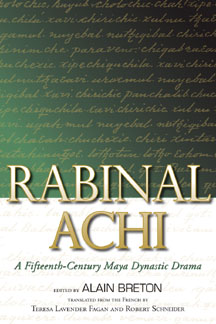
Rabinal Achi

ISBN: 978-0-87081-873-8
Binding: Paper Pages: 352 Illustrations: 77 line art illustrations, 4 maps
Published: 2007 $34.95

Rabinal Achi. A Fifteenth-Century Maya Dynastic Drama by Teresa Lavender Fagan (Translator), Robert Schneider, Translator, Alain Breton, Editor Mesoamerican Worlds Series.

The Rabinal Achi, one of the most remarkable works of Mayan literature, dates back to the 1400s. In 2005, UNESCO declared Rabinal Achi to be a Masterpiece of the Oral and Intangible Heritage of Humanity. This drama is still performed with a ritual dance in the village of Rabinal (Baja Verapaz). The drama is set in the Guatemalan highlands in the second half of the fifteenth century. In an exemplary trial that takes place in Kajyub, the capital of the Rabinaleb at that time, a captured enemy warrior (Quiché Achi) appears before the royal court. A series of combative dialogues pits the offending warrior against the local warrior (Rabinal Achi) and the king (Job Toj), reconstructing the deeds of those involved and retracing the antagonistic history of these two Mayan groups, the Quiché and the Rabinaleb. Alain Breton approaches the text from an anthropological and ethnographical perspective, demonstrating that this indigenous text reenacts pre-Columbian historic paradigms. Breton’s work is based on the Pérez Manuscript (1913), a facsimile of which is included in its entirety. Breton translated into French an entirely new transcription of the original text, and Teresa Lavender Fagan and Robert Schneider translated the text into English. Both the transcription and the translation are accompanied by detailed commentary and a glossary. Alain Breton is Research Director at the Centre National de la Recherche Scientifique in France. He is the author or co-author of fifteen books.